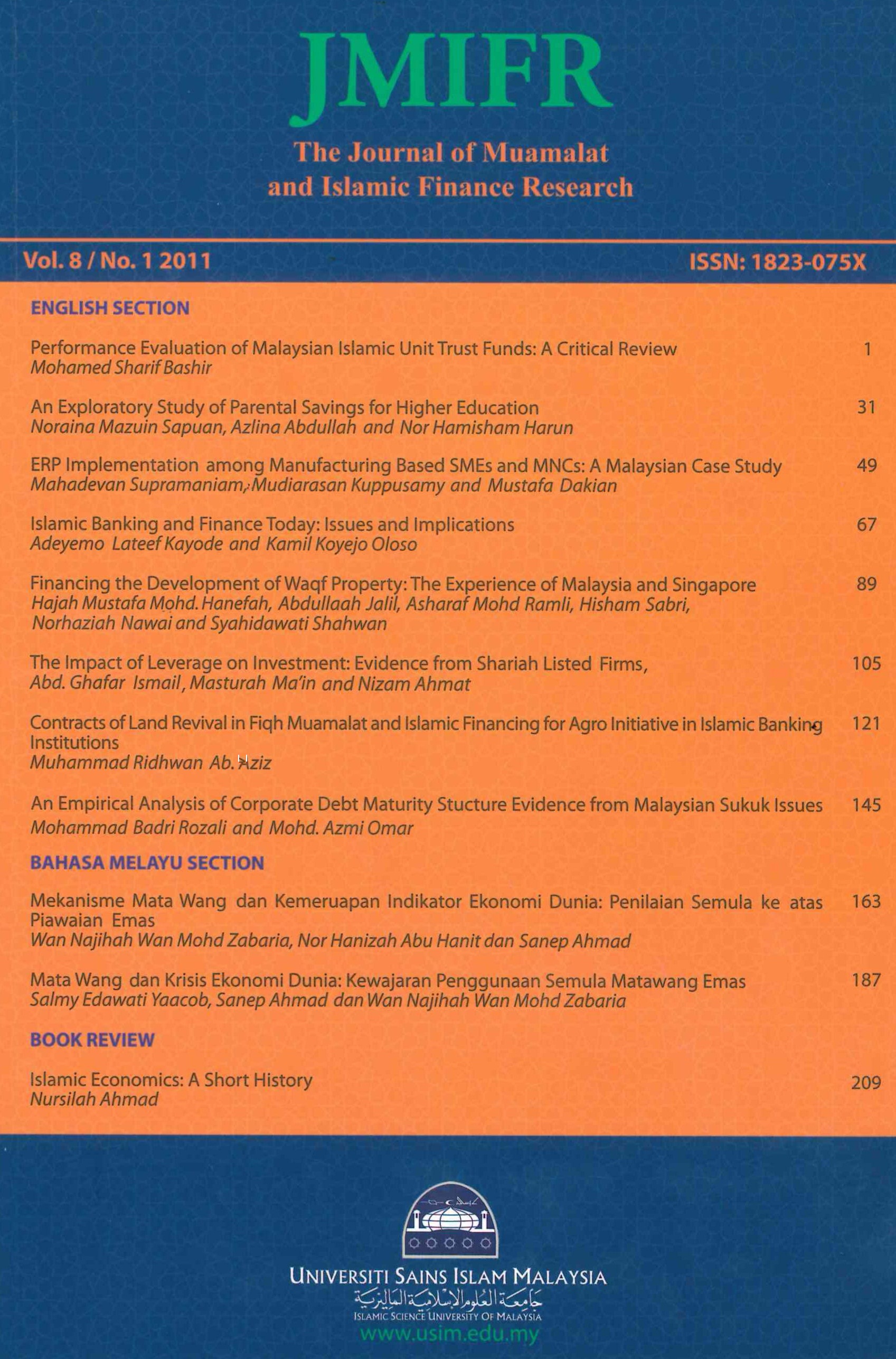
An Empirical Analysis of Corporate Debt Maturity Structure: Evidence from Malaysian Sukuk Issues
DOI:
https://doi.org/10.33102/jmifr.136Keywords:
Debt maturity, Incremental approach, SukukAbstract
Amidst vast literature on the theoretical and empirical aspects of corporate capital structure, studies on debt maturity structure vis-a-vis debt equity choice are scant and relatively new. This paper attempts to investigate the empirical determinants of the maturity of Malaysia corporate debt issues based on the incremental approach. This is done by testing several underpinning theoretical models of debt maturity structure using a cross-sectional data set of conventional bond and sukuk issues over the 1999-2007 period. The findings on conventional bond lend considerable support to the agency cost hypotheses and signaling and asymmetric information hypotheses but provide no support for tax hypotheses. in the case of sukuk issues, the evidences in general offer limited support to all testable hypotheses. Only leverage ratio under the signaling and asymmetric information hypotheses and effective tax rate under the tax hypotheses are found to have significant effects on the maturity structure of sukuk.
Downloads
Downloads
Published
How to Cite
Issue
Section
License
Copyright (c) 2011 Muhammad Badri Rozali, Mohd Azmi Omar

This work is licensed under a Creative Commons Attribution 4.0 International License.